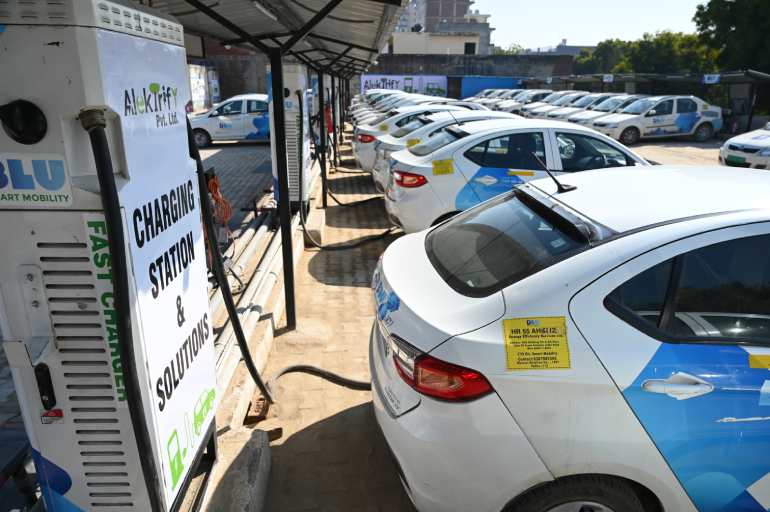
The growth of electric mobility is creating a sizeable new business opportunity: building and operating the charging infrastructure that will keep India’s growing EV fleet moving. As per Rubix Industry Insights: PV and CV industry, more than 2.3 million EVs were registered in India in 2025, while electric passenger vehicle sales crossed 1.76 lakh units, growing by 77% year-on-year. Electric three-wheeler sales also rose by 15% to nearly 800,000 units.
CPOs are central to this expansion, developing and operating charging networks across city locations, highways, fleet hubs, hotels, malls and commercial premises. According to Rubix, as of August 2026, the number of EV chargers in India had reached 67,657. With the government targeting further expansion and CII estimating a requirement of 1.32 million charging points by 2030, CPOs will increasingly need to build networks across a large number of locations.
Expanding a charging network also means managing the operational and financial requirements of each site, including its electricity costs and payments.
The Third-Party Site Model
Consider a CPO that wants to put a fast charger on a busy highway.
Buying or leasing the land, arranging the electricity supply, and building an entire facility could make the project expensive and slow to scale. Instead, the CPO can partner with an existing highway restaurant. The land, parking space, and an electricity connection are already available with the restaurant. The CPO just needs to install and operate the charger at the premises and share charging revenue with the restaurant. This model can work across hotels, malls, offices, and other commercial properties, giving Charge Point Operators access to established locations while creating an additional revenue stream for hosts.
Such a commercial arrangement, however, creates a financial dependency that the CPO may become aware of only when it is too late. Suppose the electricity connection at the highway restaurant is in the restaurant’s name. The restaurant receives the monthly utility bill and is responsible for paying it. Meanwhile, the CPO operates the charger connected to that supply and generates revenue every time an EV charges.
If the restaurant does not pay the electricity bill on time, the CPO may have no direct visibility that the bill is overdue. It may discover the problem only when the electricity supply is disrupted, and the charger stops working. This means that while the CPO’s asset may be ready and customers may be arriving to charge, the charger cannot operate because a third party has an unpaid utility bill. It then becomes the CPO’s headache to resolve a problem it does not directly control.
This limited visibility into host electricity payments is the central difficulty with third-party charging sites and a potential threat to charging-station uptime and revenue generation.
When the Electricity Bill Is Not Yours
At a network with dozens or hundreds of third-party locations, CPO finance teams may have to collect utility bills from different hosts, check amounts and due dates, establish which costs are payable by the CPO under each commercial arrangement, and reconcile payments against individual sites.
The nature of the hosts can vary considerably, from large hotel chains with structured finance processes to smaller businesses with less formal billing systems. Hence, Charge Point Operators need to manage different documentation, payment and GST requirements, including GSTIN verification where Input Tax Credit (ITC) is being claimed. Managing these processes across multiple sites can make timely billing, reconciliation, and compliance difficult.
From Bill Management to Cost Control
Electricity costs can vary from ₹6 to ₹15 per kWh, depending on the state, tariff structure, and site arrangement. Fixed and demand charges can add further costs. If a host passes electricity costs on to the CPO, the CPO needs visibility into the underlying bill. An unusually high charge could reflect greater consumption, tariff differences, demand charges, poor power factor, or other penalties. Limited visibility into utility bills and consumption parameters can make it harder for CPOs to validate costs, allocate them fairly and identify corrective action.
A Centralized Utility Bill Workflow to Close the Gap
Centralizing these dispersed financial processes improves CPO control across third-party charging sites. Vayana BillsToPay can centralise utility-bill collection and management across third-party charging sites, giving finance teams visibility into bills, payments, documentation and reconciliation. It can also support GST/ITC checks and energy-cost analysis, helping Charge Point Operators identify payment, billing and cost issues before they affect operations.
Readying the Financial Infrastructure for EV Growth
Early movers in the CPO space that establish strong networks can capitalize on the significant market opportunity in the electric mobility space. However, to capture that opportunity, they will need to build operational discipline alongside physical infrastructure, especially in third-party site arrangements. A centralized solution such as Vayana BillsToPay can help CPOs bring greater visibility and control to this part of the operation, giving finance teams a stronger handle on payments, compliance, energy costs, and site-level financial performance. Getting these foundations right can help CPOs expand with greater confidence and turn a rapidly growing charging market into a sustainable business opportunity.