Many finance leaders treat supplier onboarding like a routine bureaucratic gatekeeping exercise. Their teams collect tax registrations, incorporation certificates, and bank details, enter the vendor into the ERP, and move on. Once these steps are complete, they assume that the supplier is ready to do business.
In reality, the implications extend well beyond procurement because the quality of supplier onboarding can influence working capital requirements, supply chain finance eligibility, trade finance extension, payment efficiency, compliance exposure, supply chain continuity, and the business’ ability to manage costs. Businesses expanding their supplier networks and working with vendors across different geographies and levels of the supply chain have to get onboarding right, as the consequences of getting it wrong can be damaging.
Several aspects of supplier onboarding deserve greater attention from finance leaders and should form a core pillar of a CFO’s risk management plan.
1. The Hidden Cost of Paper Compliance vs. Dynamic Risk
In traditional onboarding, suppliers submit self-declared documents such as PAN, GST registration, financial statements, and statutory documents. This snapshot is recorded in the system, and the supplier is considered onboarded. A supplier can hold a valid GSTIN today while simultaneously defaulting on Employee Provident Fund filings, facing court litigation, or suffering acute cash flow stress.
Implications for CFOs:
Effective credit risk assessment needs to incorporate checks on financial health, payment behavior, litigation, and statutory filing patterns to create a more meaningful picture of supplier reliability. It also helps identify potential risks before they disrupt business operations or impact trade finance arrangements.
2. Ultimate Beneficial Ownership (UBO) and Shell Company Exposure
Surface-level KYC verifies the existence of a legal entity and not the identity of the one who controls or profits from it. It does not look for layered corporate structures, nominee directors of shell companies, sanctioned entities, Politically Exposed Persons (PEPs), and conflicted counterparties, creating exposure to shell companies, related-party conflicts, sanctions risks, and potentially fraudulent transactions.
Implications for CFOs:
CFOs need visibility into ownership and management structures, including relationships between seemingly unrelated entities, to avoid unknowingly entering relationships that create financial, regulatory, or reputational liabilities, especially when extending trade credit or structuring supply chain finance programs.
3. The High Cost of Delayed Onboarding Friction
Long vendor registration and verification processes pause procurement of materials or services, impacting production schedules and purchase orders. Meanwhile, project launches could get delayed, negotiating leverage with suppliers gets eroded, forced off-contract spending could occur, and the business could miss opportunities while waiting for the supplier to be approved in the system. When multiple departments handle documentation, verification, and approvals through disconnected processes, the problem is pronounced.
Implications for CFOs:
Recognize onboarding turnaround time as an operational efficiency measure with direct financial implications. Finance automation, standardized workflows, automated document collection and verification, and clearly defined approval responsibilities reduce friction while retaining the necessary controls and preserving audit-ready compliance trails.
4. Evaluating Suppliers in Silos Instead of Across the Ecosystem
When onboarding workflows assess each vendor in isolation, network risk across the broader procurement ecosystem often goes unnoticed. Multiple suppliers bidding on separate regional contracts may appear independent on paper, yet share the same directors, registered address, or UBOs. This results in concentration risk and opens the door to coordinated bid-rigging and cartel pricing.
Implications for CFOs:
Understanding how suppliers connect across procurement categories and locations by mapping interlinked entities across a company’s entire counterparty universe strengthens credit risk assessment by identifying points of failure and excessive dependence. It also helps make better sourcing decisions and develop contingency plans in case a supplier runs into trouble.
5. Fraud Risk at the Front Door
In FY2026, Indian authorities uncovered 1,517 fraudulent GST registrations obtained using forged identity documents. These entities were linked to ITC fraud amounting to ₹9,940 crore. This is usually carried out by suppliers issuing GST invoices without actually supplying goods or services. Buyers use these invoices to claim Input Tax Credit (ITC), while the suppliers issuing them may disappear without depositing the corresponding GST with the government. Fraudsters also create shell firms using stolen PAN details, misuse legitimate businesses’ identities, or route invoices through multiple entities to appear genuine. For a buyer, accepting such invoices can lead to ITC reversals, interest, penalties and tax disputes. It can also expose trade finance and supply chain finance facilities to fraudulent billing.
Implications for CFOs:
Independently verify supplier identity, ownership, GST credentials, and bank account details before vendor activation. Changes to critical information, particularly bank details, should trigger additional authentication and approval. Preventing front-door fraud requires multi-layered verification, combining official database e-KYC, promoter ID checks, document validation, and geo-tagged Video KYC, alongside conflict-of-interest screening against internal employee records.
6. Dirty Vendor Master Data
A business may be doing rigorous upfront due diligence, but the vendor master data tends to degrade when it is poorly governed. ERP systems end up accumulating duplicate vendor records, outdated bank accounts, inconsistent naming conventions, and expired tax registrations. This can lead to many problems such as:
- Double payments and fragmented spend visibility that prevents volume discounting
- Duplication of records that allows buyers to split purchase orders to bypass approval limits
- Outdated GST registrations that result in blocking of input tax credit and compliance notices
Implications for the CFO:
Maintaining a single source of truth requires standardized entry verification, including Legal Entity Identifier (LEI) validation, paired with periodic portfolio scrubs. Finance teams should leverage finance automation to periodically run bulk scrubs of their existing vendor master against live statutory filings and risk scores to purge duplicates, flag non-compliant suppliers, and restore ERP data integrity.
The Rubix Advantage
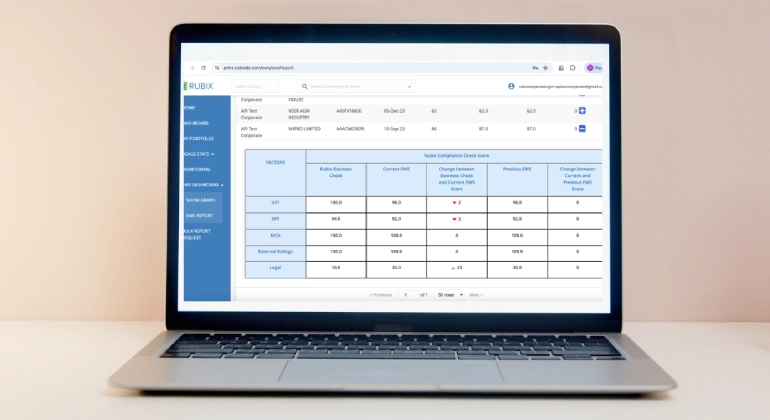
Rubix Data Sciences – A Vayana Group Company, addresses these gaps through automated dynamic risk scoring via Rubix Business Check, UBO and ecosystem mapping through Rubix Nexus Check, LEI validation, and periodic vendor Master Data Management.
Modern CFOs cannot afford to treat supplier onboarding as a back-office paperwork exercise. They need to treat it as the primary control point where working capital protection, compliance, fraud prevention, and supply chain resilience intersect. By combining automated verification, deep network intelligence, and continuous monitoring, finance leaders can turn onboarding from a hidden vulnerability into a measurable competitive advantage.
To understand how these checks could work across your supplier base, write to Rubix Data Sciences at info@rubixds.com.
Frequently Asked Questions:
1. What is supplier onboarding in supply chain finance?
Supplier onboarding is the process of verifying a supplier’s identity, ownership, financial standing, and compliance before it can become a counterparty. In supply chain finance, the quality of this process determines whether invoices can be trusted and whether a supplier qualifies for financing at all.
2. Why do CFOs need to look beyond paper compliance during supplier onboarding?
Valid GSTIN and MCA registrations only show that a supplier was compliant on the day it submitted them. A one-time document check cannot show whether the supplier has remained compliant since.
3. How does supplier onboarding affect trade finance and fraud risk?
Weak supplier onboarding allows fraudulent GST registrations and invoices to enter the system. These can expose trade finance and supply chain finance facilities to billing for goods or services that were never delivered. Independent verification of identity, ownership, and bank details before activation reduces that exposure.
4. What is UBO screening and why does it matter for supplier risk?
Ultimate Beneficial Owner (UBO) screening identifies the people who ultimately own or control a supplier, including through layered companies and shell entities. It helps spot related-party conflicts, sanctions exposure, and links to Politically Exposed Persons (PEPs) that a basic KYC check would miss.
5. How can finance automation improve supplier onboarding and vendor master data?
Automated workflows speed up document collection, verification, and approvals while maintaining audit trails. Periodic Master Data Management (MDM) against live statutory filings and risk scores remove duplicate records and expired registrations, which protects ERP data integrity and supports CFOs in risk assessment.
6. How does supplier onboarding support CFO risk management beyond compliance?
Supplier onboarding gives CFOs their first view of counterparty risk, which feeds into credit limits, payment controls, and contingency planning. When CFOs treat it as an ongoing risk process and not a one-time check, they can anticipate supplier distress before it disrupts production or payments.