It is monsoon. The IMD raises a cyclone alert for the Konkan coast, and a fisherman at Sassoon Dock hears it before his boat leaves the harbor. He stays ashore and secures the hull. Another fisherman hears it only after he has gone out into the sea. He can only turn for the coast and hope to reach on time. Trade credit works in a similar manner. If a buyer is under financial strain, the signs appear in records and filings well before they show up as an overdue payment, and the counterparty that sees them in time can protect itself before the exposure becomes a loss.
The Advantages of Being Forearmed
When a finance team gets an early alert about a weakening buyer, it can take one or all of these actions: revise the credit limit, shorten the payment terms, and still ask for collateral or a guarantee while the buyer has the ability to provide one. It can also adjust provisioning before the quarter closes. Each step protects trade receivables but becomes harder once the invoice is overdue. The benefit extends to working capital management and cashflow management because every day an invoice remains unpaid means cash is kept out of the business.
The Inadequacy of Ad-hoc Assessments
A credit assessment during onboarding or done annually describes a counterparty as it was on the day of the review. This worked earlier when conditions around a buyer changed slowly. Today, geopolitical shocks arrive within a single day and affect payments within weeks.
For instance, the military escalation in West Asia on 28 February 2026, stalled shipping through the Strait of Hormuz. The effects reached India within days. In Bhadohi, a carpet exporter’s payment cycle, which usually closed in 30 to 40 days, stretched beyond 90 days within weeks.
Annual reviews and quarterly check-ins cannot keep up with this speed. Continuous credit risk monitoring can, because it treats each change in a counterparty’s public records as a prompt to reassess. Advances in AI and data analytics have made this possible, since systems can now collect and read records from many sources near real-time at scale and update a risk score as soon as something changes.
Where the Warning Comes From
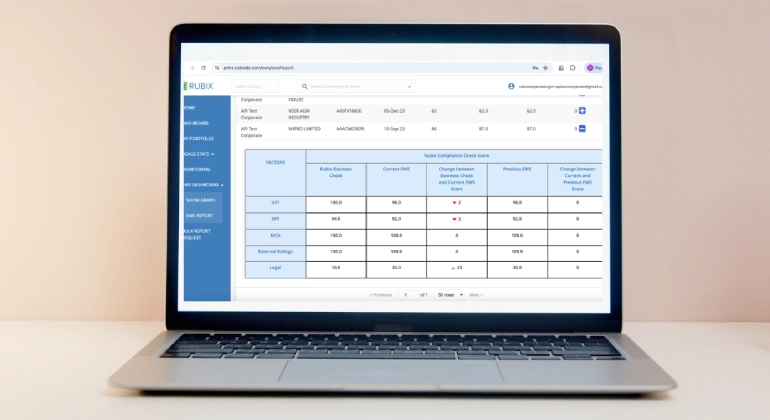
APIs help connect monitoring systems to the registries and data sources where critical parameters are recorded. Each parameter refreshes automatically, and any change shows up at once in the counterparty’s risk profile. The Rubix Early Warning System (EWS), for example, continuously monitors the following indicators for Indian companies:
- GST filing status, including delays and lapses
- MCA filings and compliance gaps
- EPF contributions, where irregularities or a sudden decline in headcount can point to payment stress or layoffs
- Litigation records, including NCLT proceedings, bounced cheque cases, and labor disputes
- Court notices and other legal trigger events
- External credit ratings, with downgrades flagged as they occur
- Media coverage and social media sentiment, including abrupt leadership changes at promoter-run companies
- Sector and geopolitical developments that bear on the counterparty’s industry
A compliance risk assessment of a counterparty is often the earliest indicator, because companies under financial strain tend to neglect statutory obligations. However, no single indicator carries a verdict. Structured monitoring has to read the signals together and score them as one picture.
India’s Regulators Are Building Forewarning Into the Rulebook
The Reserve Bank of India’s Resolution of Stressed Assets Directions, 2025 require lenders to flag developing stress immediately on default by classifying the account as a special mention account. They also have to report them to the Central Repository of Information on Large Credits (CRILC) and classify them under three bands, from up to 30 days overdue to 61 to 90 days overdue, before they are marked as NPAs. For NBFCs, the Fraud Risk Management Directions, 2026 add more obligations. Upper- and middle-layer NBFCs must maintain an early warning signal framework within their board-approved fraud risk policy and identify indicators for loan accounts as well as other financial transactions.
Similarly, under SEBI’s circular on default disclosures, a listed entity must disclose a default on a bank or financial institution loan if it has exceeded 30 days within 24 hours from the 30th day. It must also file a quarterly statement of defaults at least seven days before the quarter ends. These rules aim to spot stress early, and a counterparty’s public records provide a better warning than just payment behavior.
EWS in Action
A global media investment group required strict due diligence of every new vendor. Assessing new vendors was challenging, given the limited information available and the effort required to monitor each counterparty. The Rubix EWS platform drew on more than 120 structured and unstructured data sources and proprietary credit-risk scoring models to assess more than 720 counterparties on the Rubix ARMSTM platform across regions, business segments, and legal constitution. EWS reports were sent every quarter, and alerts were sent when the risk of a counterparty changed.
The warnings enabled effective decision-making, which helped block vendors showing signs of default or delay until compliance was regularized. Previously, the group’s risk assessment had been ad hoc, but with Rubix it became a systematic quarterly process.
The Old Advice Still Holds
Supply chain finance solutions extend funding against receivables whose quality depends on the buyer’s financial health, so an early read on that buyer protects the financier and the supplier together.
Trade credit will always carry some risk. A continuous, data-driven early warning system gives a company a head start when trouble arrives. It helps prepare finance and risk teams to meet that moment with time to act while the options are still open.
FAQs (Frequently Ask Questions)
1. What is the Rubix Early Warning System?
Rubix EWS is a continuous risk monitoring platform that keeps track of the financial, statutory, and compliance health of credit buyers and counterparties. Aggregating signals from public records, regulatory filings, and multiple external data sources, it updates risk scores and triggers timely early warning alerts whenever a counterparty’s risk profile shifts.
2. Why isn’t an annual credit review enough?
A periodic review only captures a snapshot of a counterparty on the day it is conducted. Continuous credit risk monitoring refreshes risk score in near real time as public records and filings change, ensuring credit decisions rely on current risk intelligence rather than an outdated picture.
3. How does early warning reduce trade credit risk?
Detecting early signs of financial stress in a buyer or counterparty allows credit teams to take decisive, preventative action. You can revise credit limits, tighten payment terms, or secure collateral and guarantees while the counterparty still has the liquidity to provide them. Additionally, finance teams can adjust credit loss provisions well ahead of quarter-end. Taking these proactive measures safeguards your trade receivables and protects cash flow, whereas recovery becomes significantly harder and costlier once an invoice turns overdue.
4. How does this help with working capital and cash flow?
Delayed receivables lock up vital liquidity across the business. Early-warning signals surface potential payment slippages in advance, enabling finance and risk teams to proactively calibrate working capital and cashflow management rather than reacting after exposure builds.
5. Can Rubix EWS be used for compliance risk assessment?
Yes. Counterparties experiencing financial stress frequently neglect statutory obligations before payment defaults occur. Monitoring GST filing delays, MCA compliance gaps, and EPF contribution irregularities provides actionable early warning signals so credit and risk teams can act while options remain open.
6. Why does this matter for supply chain finance solutions?
Supply chain finance solutions fund transactions against trade receivables, or receivable quality hinges directly on the buyer’s or Counterparties financial health and repayment capacity. Continuous early warning intelligence gives financiers and suppliers timely visibility into shifting buyer risk, enabling data-backed funding and working capital decisions before stress escalates.